

How to Write an IMRaD Research Paper: A Figure-First Workflow
Learn a figure-first IMRaD writing workflow that connects research questions, methods, figures, results, discussion, and a final manuscript consistency check.

On this page
- What Is the IMRaD Format?
- The Best Order for Writing an IMRaD Research Paper
- Recommended Writing Order
- Why This Order Works
- How to Write Each IMRaD Section
- Title: State the Study Precisely
- Abstract: Compress the Complete Study
- Introduction: Move from Context to Research Gap
- Methods: Make the Evidence Traceable
- Results: Report What the Evidence Shows
- Discussion: Interpret Without Overclaiming
- Conclusion: Leave One Defensible Take-Home Message
- Common Reasons Research Manuscripts Are Rejected
- 1. Out of Scope or Wrong Article Type
- 2. Unclear Novelty or Contribution
- 3. Weak or Insufficiently Reported Methods
- 4. Poor Presentation and Inconsistent Evidence
- 5. Conclusions That Exceed the Results
- 6. Formatting, Ethics, or Compliance Problems
- Pre-Submission Checklist for an IMRaD Manuscript
- Content Quality
- Figures and Tables
- Technical and Ethical Requirements
- Final Consistency Check
- How to Create Effective Manuscript Figures
- Design Guidelines
- Typography and Export Quality
- Frequently Asked Questions
- Does every research paper have to use IMRaD?
- Should I write Results before the Introduction?
- How many figures should an IMRaD paper include?
- What is the difference between Results and Discussion?
- Can AI help write an IMRaD manuscript?
- How do I turn an IMRaD paper into a graphical abstract?
- Conclusion
An IMRaD research paper is read from Introduction to Methods, Results, and Discussion, but it does not have to be written in that order. For many empirical studies, the clearest starting point is the evidence: decide which figures and tables carry the argument, then build the manuscript around what they genuinely show.
This guide follows the complete journey from understanding IMRaD to checking a submission-ready manuscript. Its figure-first workflow connects each research question to a method, each result to visible evidence, and each conclusion to an appropriate level of certainty.
What Is the IMRaD Format?
IMRaD is the common Introduction–Methods–Results–Discussion structure used for original empirical research. Each section answers a different reader question:
| Section | Reader's question | Primary job |
|---|---|---|
| Introduction | Why was this study needed? | Establish the context, gap, and objective |
| Methods | How was the study performed? | Document the design, procedures, and analysis |
| Results | What was found? | Present observations, comparisons, and uncertainty |
| Discussion | What do the findings mean? | Interpret the evidence, limitations, and implications |
The ICMJE manuscript recommendations describe IMRaD as a usual structure, not a universal rule. Reviews, protocols, case reports, qualitative studies, and brief communications may require another format. Read your target journal's instructions and recent articles before adopting any template; Nature Portfolio's writing guidance likewise emphasizes that section and formatting requirements vary by journal.
The Best Order for Writing an IMRaD Research Paper
Recommended Writing Order
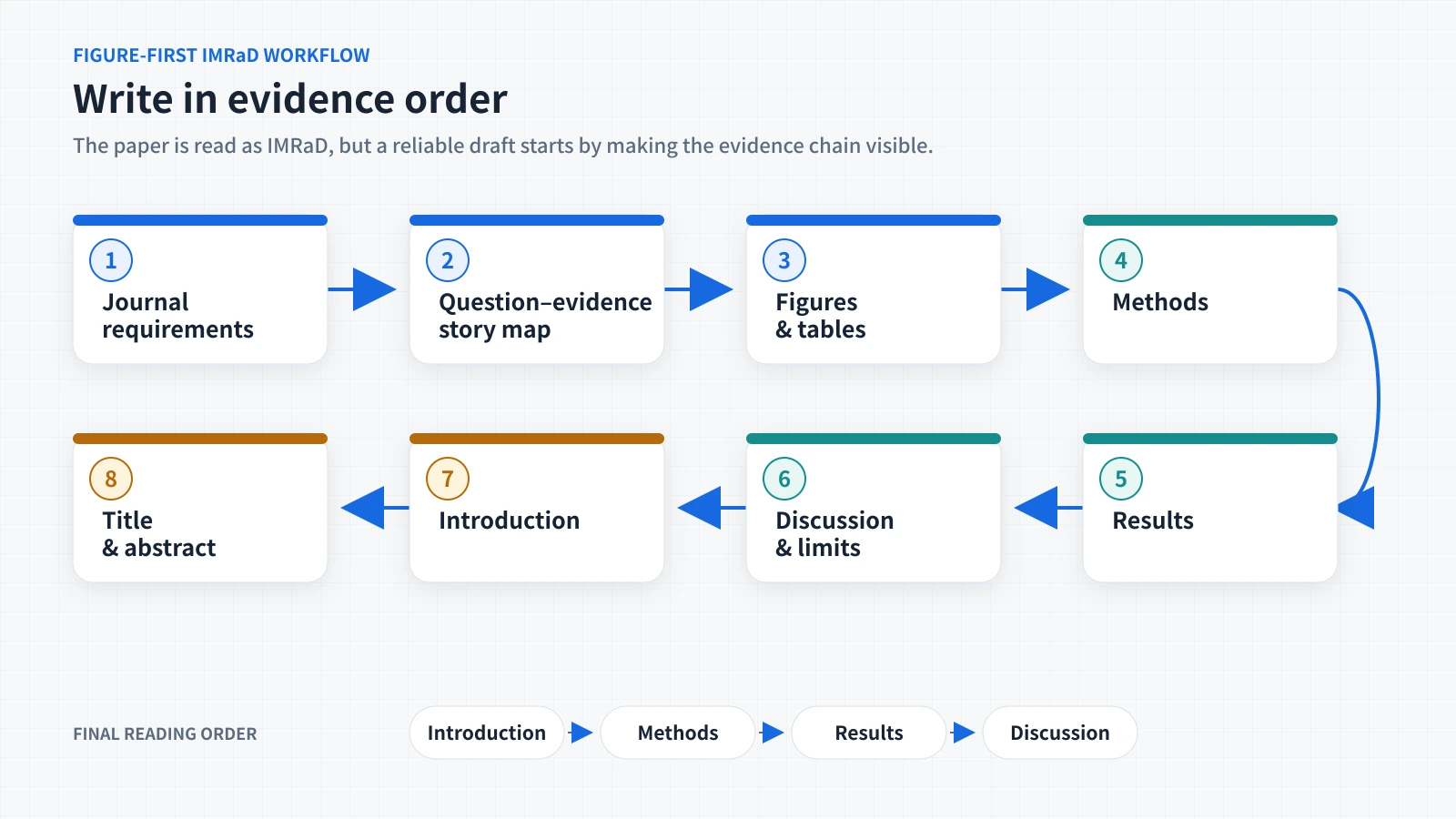
A practical evidence-led order is:
- Confirm the article type and journal requirements.
- Map each research question to its method and evidence.
- Arrange rough figures and tables into an evidence sequence.
- Draft Methods.
- Draft Results around the figures and tables.
- Draft Discussion, including limitations.
- Write Introduction backward from the final objective.
- Write the title and abstract after the argument is stable.
The one-page story map below prevents a section from drifting away from the study it is supposed to report:
| Story element | Planning question | Manuscript destination |
|---|---|---|
| Research gap | What remains unknown? | Introduction |
| Objective | What did the study test, estimate, or describe? | End of Introduction |
| Method | What produced the relevant evidence? | Methods subsection |
| Evidence | Which figure, table, or observation answers the question? | Results subsection |
| Interpretation | What is the narrowest defensible meaning? | Discussion |
| Boundary | What limitation or alternative remains? | Discussion and abstract |
Why This Order Works
Figures and tables reveal the real shape of a study. Arranging them early exposes missing links: a question with no result, a result with no documented method, or a conclusion that reaches beyond the evidence. Rough panels, table shells, and written figure briefs are sufficient; polished artwork is not required at this stage.
If a story-map row has no evidence, narrow the question, add a scientifically justified analysis, or remove the unsupported branch. Stronger prose cannot repair a broken evidence chain.
How to Write Each IMRaD Section
Title: State the Study Precisely
Use terms your intended readers search for and identify the study without exaggerating its scope. Avoid promising a mechanism, population, or causal effect that the design did not establish. Follow the journal's rules for study-design labels, length, and subtitles.
Abstract: Compress the Complete Study
Write the abstract last. It should stand alone and preserve the same objective, essential method, principal result, and limitations as the manuscript. Because compression can remove qualifiers, compare every abstract claim with the corresponding Results and Discussion text. The target journal—not a universal number—determines the word limit and whether headings are required.
Introduction: Move from Context to Research Gap
Use a funnel: establish the relevant context, identify the unresolved gap, and finish with the specific objective or hypothesis. Writing the final paragraph first often helps. Then add only the background needed to understand why that objective matters, rather than turning the Introduction into a broad literature review.
Methods: Make the Evidence Traceable
Write from protocols, analysis scripts, preregistrations, laboratory records, and approved study documents rather than memory. An informed reader should be able to assess how the evidence was produced and, where appropriate, reproduce the work. If a result depends on preprocessing, exclusion criteria, model selection, or a statistical test, the method must be easy to find.
Use the relevant reporting guideline for completeness. The EQUATOR Network helps researchers locate guidelines by study type, but the journal's instructions still control the submission format.
Results: Report What the Evidence Shows
Organize Results around questions, not file names. Start with the comparison, point to the figure or table, and state the observation with the necessary quantitative or qualitative context. Do not repeat every plotted value or interpret the broader significance here.
A useful drafting pattern is: “To determine whether [question], we used [method]. [Figure or table] shows [observation]. This result [answers the narrow question].” For a hypothetical cell-migration study, the sequence might move from design and quality controls, to the primary observation, to a robustness test or boundary condition.
Discussion: Interpret Without Overclaiming
For each major result, make four moves: state the interpretation, compare it with prior evidence, explain the limitation or alternative, and describe the implication at the level the evidence supports. Association is not automatically causation, a model output is not clinical evidence, and a result from one setting may not generalize to another.
Conclusion: Leave One Defensible Take-Home Message
Conclude with the answer the study can support, why it matters, and the most important boundary. Do not introduce new data or simply repeat the abstract. If the journal combines Discussion and Conclusion, use the final paragraph for this function.
Common Reasons Research Manuscripts Are Rejected
1. Out of Scope or Wrong Article Type
Editors can reject a technically sound study when it does not fit the journal's audience, scope, or accepted article types. Check aims, recent content, and author instructions before tailoring the manuscript.
2. Unclear Novelty or Contribution
Novelty is not a claim that the work is “first.” Show exactly what gap is addressed and how the study changes what a reader can know or do. The Introduction, figures, and Discussion should tell the same contribution story.
3. Weak or Insufficiently Reported Methods
A question may matter but still be unsupported by the design, sampling, controls, analysis, or reporting detail. Use the appropriate checklist early, not as paperwork after drafting.
4. Poor Presentation and Inconsistent Evidence
Unclear prose, unreadable figures, mismatched labels, and a Results section that does not follow the evidence make valid work difficult to evaluate. Springer Nature's overview of common rejection reasons includes poor presentation and failure to follow instructions among preventable problems.
5. Conclusions That Exceed the Results
Reviewers look for a traceable route from method to result to claim. Restore qualifiers, distinguish association from causation, and state limits where readers need them—not only in a final limitations paragraph.
6. Formatting, Ethics, or Compliance Problems
Missing ethics statements, reporting items, declarations, files, or journal-specific formatting can delay review or lead to rejection. Elsevier's summary of common paper-rejection causes similarly stresses journal fit, sound methods, supported conclusions, and compliance with instructions.
Pre-Submission Checklist for an IMRaD Manuscript
Content Quality
- Every objective is answered or explicitly left unresolved.
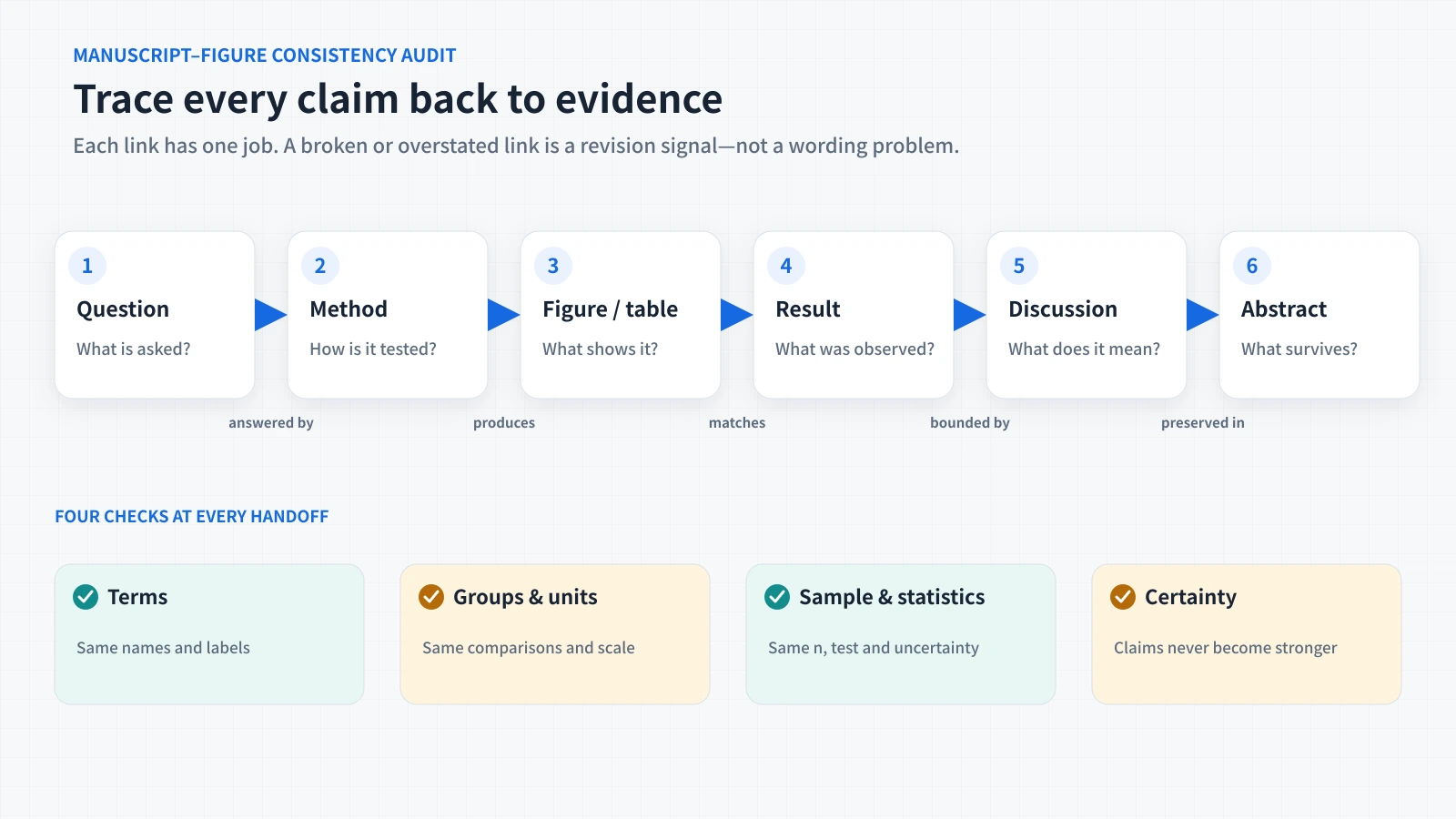
- Every major conclusion traces to a Result, and every Result to a documented method.
- References support the statements to which they are attached.
- Causal language appears only when the design supports it.
Figures and Tables
- Display items are cited in the order readers encounter them.
- Captions define panels, symbols, abbreviations, units, and essential analysis details.
- Group names, values, uncertainty, and statistical descriptions match the manuscript.
- Every figure remains legible at its intended publication size.
Technical and Ethical Requirements
- Article type, word limits, files, and reporting checklist match the journal.
- Ethics, consent, data and code availability, funding, authorship, and conflicts are reported where required.
- References, supplementary files, figure formats, and accessibility requirements are complete.
Final Consistency Check
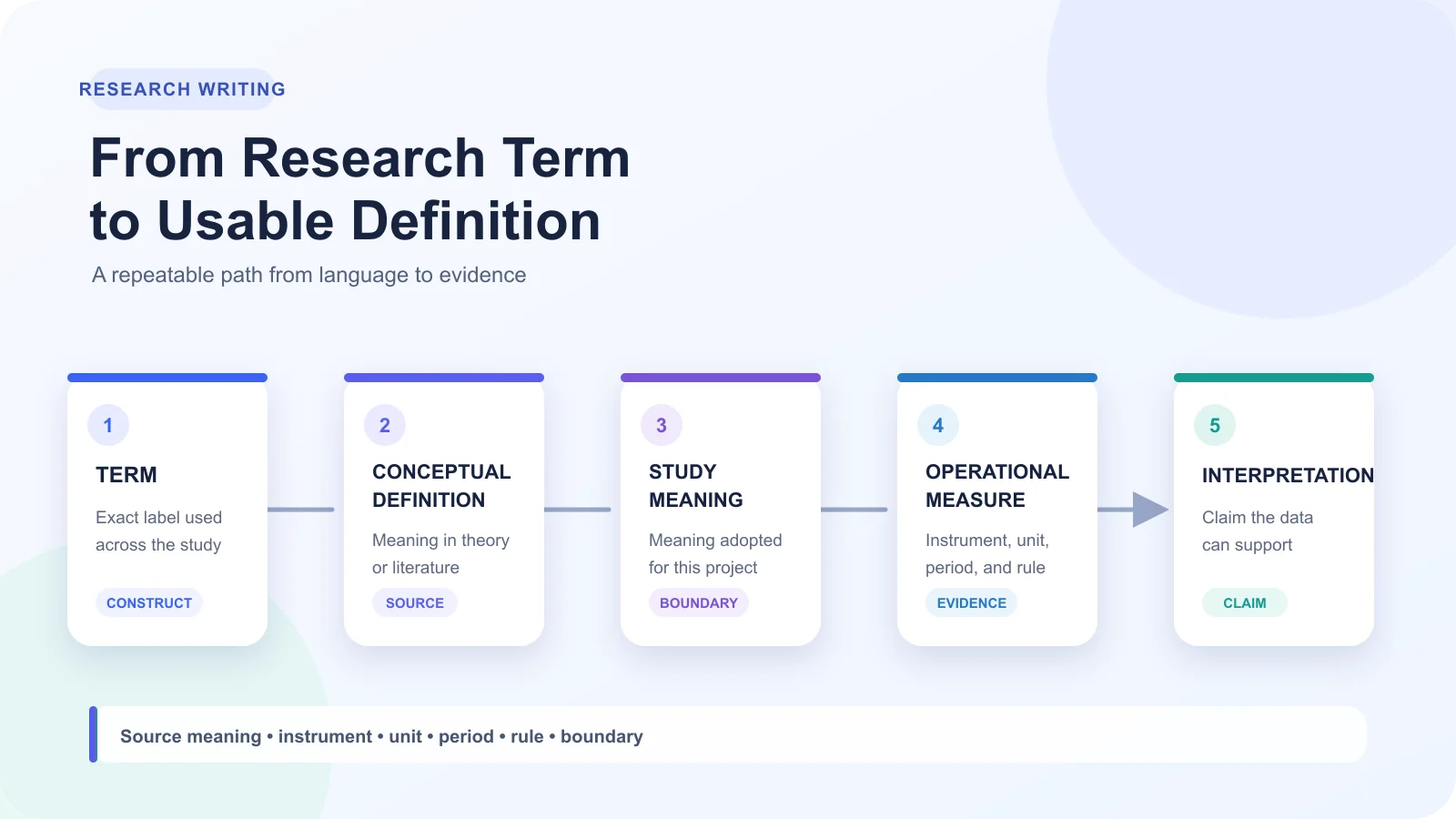
Follow every figure citation from Methods to Results, Discussion, and abstract. Confirm that each location describes the same evidence with the same terminology and certainty. If a construct or variable changes meaning across sections, return to the conceptual and operational definitions guide and standardize the term before export. Inspect the exported files rather than assuming the editing canvas and final output are identical.
How to Create Effective Manuscript Figures
Design Guidelines
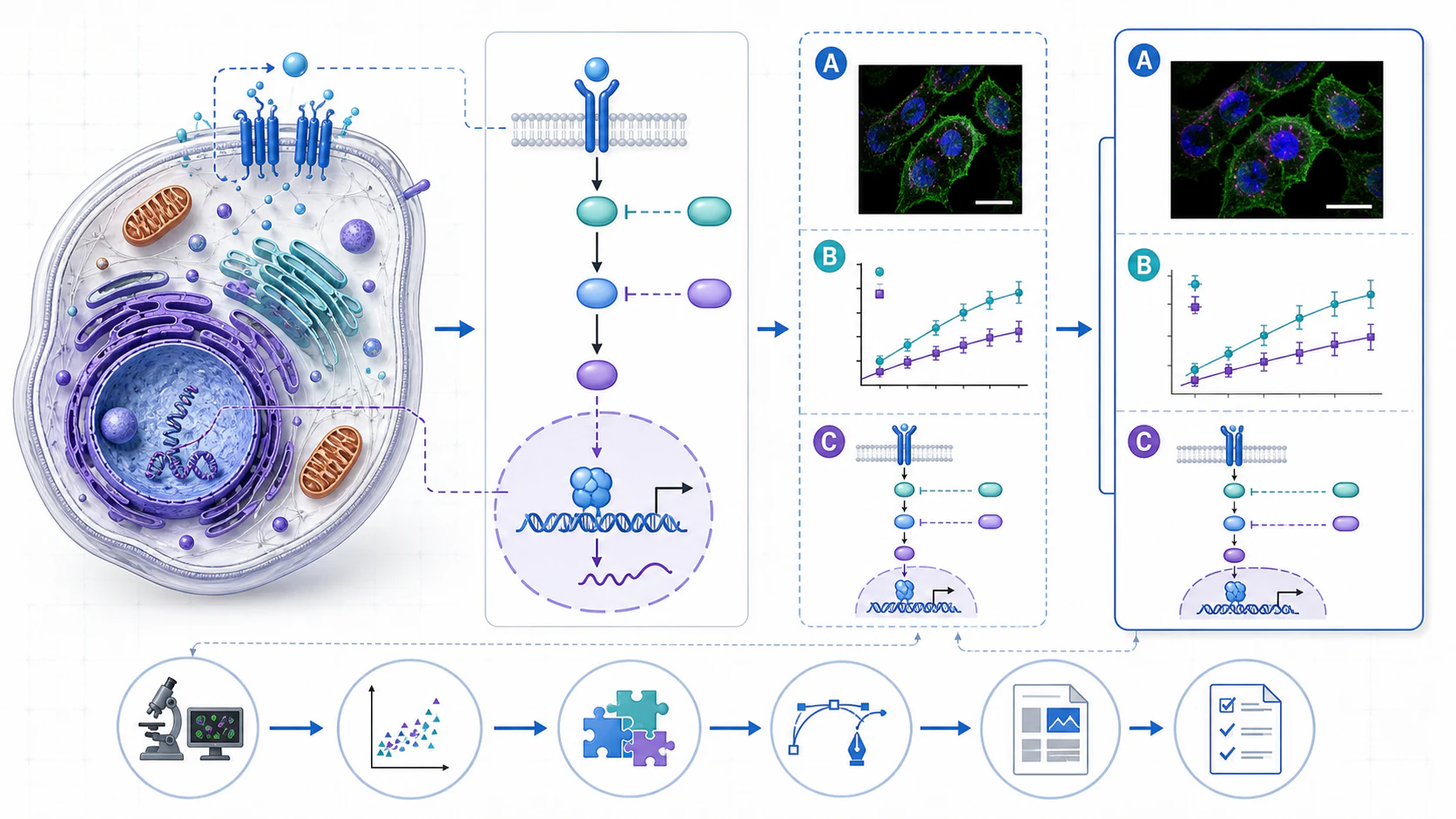
Give each figure one job and draft a brief containing the question answered, data source, required panels, main comparison, uncertainty, one-sentence takeaway, and visible limitation. Use consistent encodings and a reading order that matches the Results. Avoid decorative detail that does not carry information.
You can use FigEditor Studio to turn a method, mechanism, sketch, or reference image into an editable starting point. Scientific labels, relationships, values, and claims must still be checked against source material before publication.
Typography and Export Quality
Use a small, consistent type system; make panel labels, units, legends, and axis text readable at final size; and check contrast without relying on color alone. Keep diagrams and text as editable vector artwork when accepted, while exporting photographic content to the journal's required resolution and color settings. Nature's research figure specifications explain why one resolution rule cannot cover every figure type.
If the same research story needs a compact visual summary or conference format, use the Graphical Abstract Maker or Scientific Poster Maker, then verify the generated output against the final manuscript.
Frequently Asked Questions
Does every research paper have to use IMRaD?
No. IMRaD is common for original empirical research, but article types and disciplines vary. Follow the target journal and relevant reporting guideline instead of forcing an unsuitable structure.
Should I write Results before the Introduction?
Often, yes—once the analysis is stable. Results reveal what the study actually demonstrates, making it easier to write an Introduction that leads to the correct objective. This is a workflow option, not a formal rule.
How many figures should an IMRaD paper include?
There is no universal number. Include the figures needed to support the argument, then apply the journal's display-item limits. Combine panels only when they answer one coherent question and remain readable.
What is the difference between Results and Discussion?
Results state what was observed with the necessary context. Discussion explains what the findings mean, how they relate to prior work, what limits the interpretation, and why the result matters.
Can AI help write an IMRaD manuscript?
AI can help organize an outline, compare terminology, summarize notes, or draft a visual structure. Researchers remain responsible for accuracy, citations, confidentiality, authorship rules, disclosure, and every scientific claim. Check the journal's current AI policy.
How do I turn an IMRaD paper into a graphical abstract?
Reduce it to one question, the essential method or mechanism, the main supported outcome, and a necessary limitation. Do not reproduce every section or introduce a stronger claim than the manuscript supports.
Conclusion
A strong IMRaD research paper is not merely four correctly named sections. It is a traceable argument in which questions, methods, figures, results, and interpretations agree. Build the evidence chain first, draft each section for its specific job, and finish with a manuscript–figure consistency check. That sequence makes gaps visible before submission and revisions easier to control.
Turn your evidence chain into an editable scientific figure.
Once the manuscript logic is stable, use FigEditor Studio to turn a method, mechanism, sketch, or reference image into an editable figure. Refine labels, arrows, and layout through each review round instead of rebuilding the visual from scratch.
Create your first scientific figure in FigEditor Studio →
Need a paper-level visual summary or a conference deliverable? Continue with the Graphical Abstract Maker or Scientific Poster Maker.