

Definition of Terms in Research: Format, 5 Examples, and Template
Definition of terms in research with a thesis-ready format, five examples, an operational definition template, and practical quality checks.
On this page
- Quick Answer: What Is Definition of Terms in Research?
- What a Definition of Terms in Research Section Does
- Where Definition of Terms Goes in a Thesis or Research Paper
- Which Terms Belong in a Definition of Terms in Research Section?
- Terms that usually need definitions
- Terms that usually do not need definitions
- Conceptual vs. Operational Definitions
- Definition of Terms vs. Glossary, Scope, and Methods
- How to Write Definition of Terms in Research
- 1. Extract candidate terms from the study design
- 2. Classify each candidate
- 3. Find an authoritative source for the conceptual meaning
- 4. Add the study-specific operation
- 5. Test conceptual fit
- 6. Organize and format the entries
- Use a Six-Field Definition Card
- Weak vs. Strong Definition of Terms Examples
- Definition of Terms in Research Examples
- Quantitative education example
- Psychology example with both definition types
- Engineering example
- Qualitative research example
- Data science example
- Complete Definition of Terms Example for One Study
- Definition of Terms
- How Definitions Change by Research Design
- Definition of Terms in Research Format and Template
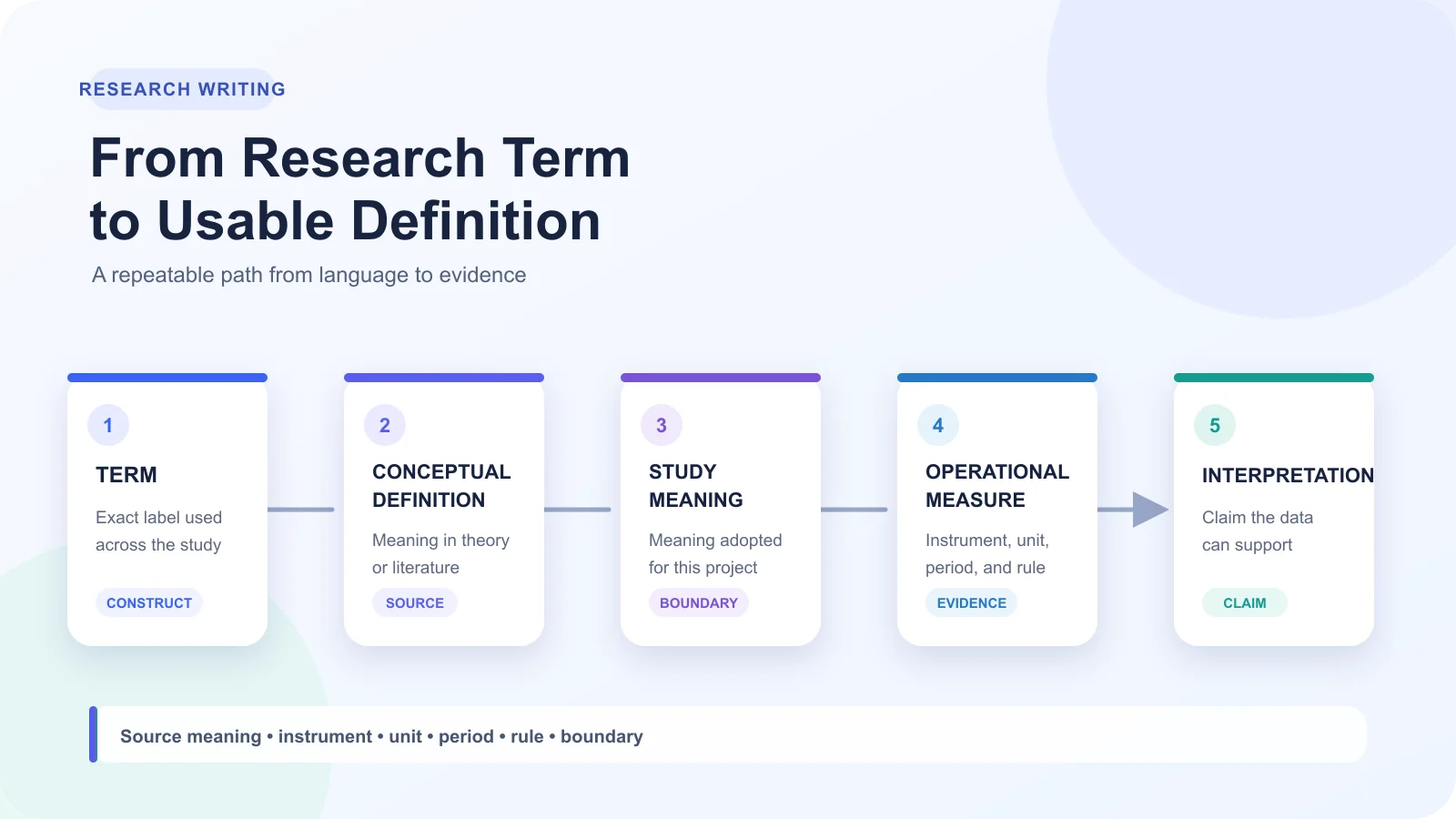
- Visualize the Path From Term to Measurement
- Common Definition of Terms in Research Mistakes
- Copying a dictionary instead of defining the study
- Writing a circular definition
- Using vague language instead of a decision rule
- Treating an instrument name as a complete definition
- Inventing a cutoff without a rationale
- Omitting the source or rationale
- Mixing the conceptual and operational levels
- Defining terms that never appear again
- Changing labels across sections
- Claiming a universal format
- Definition of Terms in Research Checklist
- Frequently Asked Questions
- What is the definition of terms in research?
- What is an operational definition in research?
- What is the difference between conceptual and operational definitions?
- Should definition of terms be in alphabetical order?
- How many terms should be included?
- Where is definition of terms located in Chapter 1?
- Do definitions need citations?
- Can a definition include a diagram?
- Can I create my own term in a research paper?
- What is the difference between definition of terms and scope of the study?
- What if a term has multiple definitions in the literature?
- Should acronyms be included in the Definition of Terms section?
- Conclusion: Define the Study, Not Just the Word
- References
Definition of terms in research is the section that fixes the meaning of the words that shape a study. It tells readers what a key concept means, how a variable is measured, and where a study-specific boundary begins and ends. The useful version is not a copied dictionary. It connects language to the evidence the study will collect.
Key takeaways
- Define terms that affect the question, variables, method, population, or interpretation.
- Separate a concept's theoretical meaning from the way the study observes or measures it.
- Cite definitions drawn from literature and label study-specific choices clearly.
- Use one term consistently after defining it.
- Follow the university, department, supervisor, or journal guide for placement and format.
Quick Answer: What Is Definition of Terms in Research?
Definition of terms in research explains how a study uses its key concepts, variables, technical expressions, and abbreviations. A complete entry gives the source-based meaning when one is needed, then states the study's exact measurement, classification, threshold, or boundary. Readers should be able to connect the term to the method without guessing.
Copyable format: Term. [Conceptual meaning] (Author, Year). In this study, [term] is operationally defined as [measure or procedure, unit, time period, scoring rule, and boundary].
The section creates a shared vocabulary for the paper. It lets a reader answer four questions without guessing:
- What does this term mean in the relevant field?
- What does it mean in this study?
- How will the researcher recognize or measure it?
- Will the same term keep that meaning throughout the paper?
That final question matters. Caraga State University's research guidance describes a definition-of-terms section as an alphabetical list of important or ambiguous terms and stresses consistent use across the proposal and thesis (Caraga State University, n.d.).
What a Definition of Terms in Research Section Does
A good definition section controls interpretation. Words such as engagement, success, quality, risk, access, or performance may sound familiar, yet each can represent several constructs or measurements. The section states which meaning the study adopts.
California State University, Chico places "Definition of Terms" among the components of the thesis introduction and advises writers to define special terms and establish abbreviations used throughout the text (Chico State, n.d.). That guidance points to two distinct jobs:
- Reader orientation: explain specialized, ambiguous, or unfamiliar language.
- Research specification: state how the study turns a concept into observable evidence.
The second job is often more important. The APA Dictionary of Psychology defines an operational definition through the procedures, actions, or processes by which something can be observed and measured. In practical terms, "academic performance" remains broad until the paper states whether it means final course grade, cumulative GPA, a standardized test score, or another indicator.
Definitions also expose design gaps. If a researcher cannot state how a variable will be identified, the method may not be ready. Andrade (2021) warns that careless operationalization produces poor measurement and weak data. Writing the section is therefore part of research design, not a formatting task performed after the study is complete.
Where Definition of Terms Goes in a Thesis or Research Paper
The placement of definition of terms in research is not universal. The correct location comes from the document type and the governing style guide.
| Document | Common location | Best reason to use it there |
|---|---|---|
| Thesis or dissertation | Chapter 1 or the introductory chapter | Readers meet the study's language before the full literature review and method |
| Research proposal | Near the introduction, research questions, or design | Reviewers can evaluate constructs and planned measurements early |
| Journal article | Introduction, Methods, a terminology note, or inline at first use | Shorter formats often integrate definitions instead of using a separate glossary |
| Long technical report | Front matter, glossary, or appendix | Readers need a stable reference for repeated specialized language |

Chico State's thesis overview places special-term definitions in the introduction. Monash University's proposal guidance treats a glossary more flexibly and recommends placing specialized terms where readers can locate them easily (Monash University, 2023). These are compatible principles, not competing universal rules.
Use this priority order:
- University or graduate-school manual
- Department or program template
- Supervisor or committee instruction
- Target journal author guidelines
- A clear and consistent fallback chosen for the reader
If the required guide says "Chapter 1," use Chapter 1. If a journal has no standalone definition section, define a term at first use and put its measurement details in Methods.
Which Terms Belong in a Definition of Terms in Research Section?
Define a term when changing its meaning would change the research question, method, result, or reader interpretation. This test is more reliable than targeting an arbitrary number of entries.
Terms that usually need definitions
- Core constructs: concepts such as trust, resilience, adoption, disease severity, or social capital that organize the study.
- Study variables: independent, dependent, control, moderator, mediator, exposure, and outcome variables.
- Operational criteria: thresholds, scoring rules, classifications, inclusion rules, and measurement windows.
- Technical language: field-specific terms that the intended reader may not know or that have several accepted meanings.
- Study-specific labels: names created for cohorts, interventions, workflow stages, categories, or derived metrics.
- Ambiguous common words: ordinary terms used in a narrow sense, such as "active," "high-performing," "rural," or "recent."
- Important abbreviations: abbreviations repeated throughout the paper, especially when the same letters can mean different things.
Terms that usually do not need definitions
- Common words used in their ordinary sense
- Every noun in the title
- Terms used once and already clear from the sentence
- Background concepts that do not affect the design or interpretation
- Dictionary entries added only to make the section longer
- Abbreviations that appear once and can be expanded at first use
Use a five-question filter for every candidate term:
| Question | Define it when the answer is yes |
|---|---|
| Could a reasonable reader interpret it in more than one way? | The paper needs a chosen meaning |
| Does it name a variable, construct, population, or outcome? | The design depends on it |
| Does the study use a threshold, instrument, or classification rule? | The operational rule must be visible |
| Does the field use the term differently from everyday speech? | A technical definition prevents confusion |
| Would changing the definition change the result or conclusion? | The definition is analytically important |
Conceptual vs. Operational Definitions
The most useful distinction in a definition of terms in research is between what a concept means and how the study observes it.
| Definition type | Main question | Typical content | Example for "sleep duration" |
|---|---|---|---|
| Conceptual definition | What does the construct mean? | A theory-based or literature-based explanation | The amount of time a person spends asleep during a defined sleep period |
| Operational definition | How will this study observe or measure it? | Instrument, procedure, unit, time window, score, and rule | Minutes between sleep onset and final awakening, recorded by wrist actigraphy for seven nights |
| Stipulative or study-specific definition | What meaning will this paper assign to the term? | A clear boundary chosen for the study | "Short sleep" means a seven-night mean below six hours |
| Lexical or dictionary definition | What does the word mean in ordinary use? | A general-language meaning | Useful only when ordinary meaning is relevant and insufficiently clear |

William Paterson University's research-methods text describes conceptual definitions as explanations of what concepts mean and operationalization as the process of specifying how those concepts will be measured (William Paterson University, n.d.). It identifies three parts of an operational definition: the variable and its attributes, the measure, and the way the collected data will support an interpretation.
One entry may need both forms:
Student engagement. Conceptually, student engagement refers to a learner's participation in academic activity across the dimensions adopted by the study. In this research, it is operationalized as the mean score on [instrument name and version], calculated from [items or subscales] on a [response scale] during [time window]. Higher scores indicate [interpretation].
The conceptual sentence establishes meaning. The operational sentence makes the measurement auditable. Neither sentence can substitute for the other.
Definition of Terms vs. Glossary, Scope, and Methods
A definition of terms in research can overlap with a glossary, scope statement, and Methods, but each section does different work. Use the definition section to fix meaning, then put the full evidence needed to reproduce a decision in Methods.
| Section | Question it answers | What belongs there |
|---|---|---|
| Definition of Terms | What does this study mean by the term? | Conceptual meaning, study-specific meaning, and a concise operational rule |
| Glossary | What does this specialized word or abbreviation mean? | Short lookup definitions for recurring technical language |
| Scope and delimitations | What people, settings, dates, or cases does the study cover? | Inclusion boundaries and researcher-chosen exclusions |
| Methods | Exactly how was the value or category produced? | Instrument version, procedure, coding, formula, timing, quality control, and edge-case handling |
The sections should point to one another without repeating entire paragraphs. For example, Chapter 1 can define "high engagement" as a score at or above a stated threshold. Methods should then explain the instrument, item scoring, missing-data rule, and reason for that threshold. Scope should identify the population and period to which the rule applies.
How to Write Definition of Terms in Research
1. Extract candidate terms from the study design
Start with the title, research questions, hypotheses or objectives, conceptual framework, inclusion criteria, instruments, and analysis plan. Highlight every construct, variable, population label, threshold, and technical expression.
Do not begin with a dictionary. Begin with the decisions the study has already made.
2. Classify each candidate
Mark each item as conceptual, operational, study-specific, technical, or an abbreviation. A term can carry more than one label. A core variable often needs a conceptual source and an operational rule.
Remove common words that do not change the study. This keeps the section focused.
3. Find an authoritative source for the conceptual meaning
Prefer sources that own or establish the definition:
- A seminal peer-reviewed paper for a theoretical construct
- A current standard or professional body for a technical term
- The official manual for a validated instrument
- A reporting guideline for study-design language
- A scholarly textbook when it accurately represents disciplinary consensus
Check the source in full. A search-result excerpt is not enough to verify scope, wording, or context.
4. Add the study-specific operation
State what the researcher will observe, calculate, classify, or decide. Include the details a second researcher would need to apply the same rule:
- Unit or response scale
- Instrument and version
- Data source
- Time window
- Inclusion or exclusion boundary
- Formula or scoring method
- Cutoff and direction of interpretation
- Treatment of missing or borderline values when relevant
Avoid writing "measured by a questionnaire" when the study can name the questionnaire, subscale, scoring rule, and interpretation.
5. Test conceptual fit
Ask whether the operation still represents the concept. A convenient proxy can be precise and still measure the wrong thing. For example, defining "learning" only as course attendance would describe presence, not necessarily knowledge or skill.
Use this audit chain:
| Research element | Audit question |
|---|---|
| Construct | What idea does the study claim to examine? |
| Conceptual definition | Which dimensions belong to that idea? |
| Indicator | What observable sign represents each relevant dimension? |
| Instrument or procedure | How will the study record the indicator? |
| Scoring rule | How will raw observations become a value or category? |
| Interpretation | What claim will that value support, and what will it not support? |
6. Organize and format the entries
Alphabetical order works well for a long reference section. Order of appearance can work for a short section whose concepts build on one another. The institution's format wins when it specifies one.
Choose one entry pattern and keep it:
Term. Conceptual definition with a citation. In this study, the term is
operationally defined as [instrument, procedure, unit, time window, scoring
rule, threshold, and interpretation].
Then run a consistency search across the paper. If the definition uses "participants," do not switch casually among "subjects," "respondents," and "users."
Use a Six-Field Definition Card
Before turning a term into polished prose, complete one definition card. The card separates decisions that weak entries often compress into a vague sentence.
| Field | What to record | Failure it prevents |
|---|---|---|
| Term | The exact label used in the title, question, or method | Synonyms drifting across chapters |
| Source meaning | The theory, standard, or literature-based meaning | A definition with no disciplinary basis |
| Study meaning | The part of that meaning this project adopts | A broad concept hiding a narrow claim |
| Observation rule | Instrument, procedure, indicator, unit, or code | "Measured by a survey" with no usable detail |
| Boundary rule | Population, threshold, period, exclusions, and edge cases | Readers applying the definition to the wrong cases |
| Manuscript locations | Every section, table, figure, and variable name that uses the term | Chapter 1 and Methods using different meanings |

Here is a completed card for one of the examples below:
| Field | Entry |
|---|---|
| Term | Assignment completion rate |
| Source meaning | Proportion of required work completed within a defined course period |
| Study meaning | Required assignments submitted by the deadline during a 12-week course |
| Observation rule | Count qualifying learning-management-system submissions, divide by required assignments, and report as a percentage |
| Boundary rule | Late and excused submissions remain separate; optional work is excluded |
| Manuscript locations | Research question, Methods, descriptive-results table, and limitations |
The card is an editorial tool, not a reporting standard. Its value is diagnostic: a blank field identifies a decision that the researcher may still need to make. Once all six fields agree, compress them into the format required by the institution or journal.
Weak vs. Strong Definition of Terms Examples
The most useful definition of terms in research examples contrast a vague label with an applicable rule. A strong definition is not necessarily longer; it removes the choice that would otherwise be left to the reader.
| Term | Weak definition | Stronger definition |
|---|---|---|
| Student engagement | Students' involvement in class | The mean score on the named engagement scale and version, using the stated subscales, response range, scoring direction, and observation point |
| Rural school | A school outside a city | A school classified as rural under the named official scheme and edition, applied to the campus location in the study year |
| Recent publication | A newly published paper | An eligible paper published from January 1, 2022, through the final search date of August 1, 2026 |
| High performer | A participant who performs well | A participant whose prespecified primary score meets the stated cutoff, with the cutoff source and borderline rule reported |
The weak versions name an idea but leave the measurement, authority, period, or boundary open. The stronger versions show which details must be supplied; placeholders such as "named scale" still need to be replaced with the actual study information.
Definition of Terms in Research Examples
The five examples below show definition of terms in research across education, psychology, engineering, qualitative research, and data science. They are fictional demonstrations of format and detail, not validated instruments or recommended cutoffs.
Quantitative education example
Assignment completion rate. In this study, assignment completion rate is the percentage of required assignments submitted by the course deadline during the 12-week observation period. A submission counts as complete when the learning-management system records a file or form response before the deadline. Late and excused submissions are reported separately.
This entry states the numerator, denominator, source, period, and exception rule. "Students who complete most work" would not.
Psychology example with both definition types
Perceived stress. Conceptually, perceived stress is the degree to which a person appraises recent life situations as unpredictable, uncontrollable, or overloaded under the framework adopted by the study. Operationally, it is the total score from [named instrument and version], administered at baseline and week eight, scored according to the instrument manual.
The final paper must replace brackets with the actual instrument and cite both the conceptual source and the manual.
Engineering example
System recovery time. In this experiment, system recovery time is the elapsed time in seconds between fault injection and restoration of the specified service-health criteria. The timer starts when the monitoring system confirms the injected fault and stops after all required health checks remain within threshold for 60 consecutive seconds.
The entry defines the event, clock, endpoint, stability period, and unit.
Qualitative research example
First-generation student. For this study, a first-generation student is a participant who reports that no parent or guardian completed a four-year university degree before the participant enrolled. The term is used as a sampling and descriptive category, not as a claim that all participants share the same educational experience.
Qualitative definitions can specify sampling boundaries and interpretive use without turning every concept into a numeric variable.
Data science example
Model performance. In this study, model performance refers to macro-averaged F1 score on the locked external test set. Training and validation results are reported separately and are not used as the primary performance estimate.
This definition prevents the paper from using "performance" to mean accuracy in one section and F1 score in another.
Complete Definition of Terms Example for One Study
Individual examples show sentence structure, but a thesis section must also work as a set. The fictional study below asks how course notifications relate to sustained attention among first-year university students. Its entries are alphabetical and use the same population, observation period, and data sources.
Definition of Terms
First-year student. For this study, a first-year student is a participant enrolled in the first two semesters of their first undergraduate degree at the study university. Transfer students entering with second-year standing are excluded.
Learning management system (LMS). The LMS is the institution-approved platform that delivers course materials and records course notifications. "LMS" is established at first use and retained throughout the paper.
Notification frequency. In this study, notification frequency is the number of course-related push notifications delivered through the LMS during each seven-day observation period. Duplicate delivery events and messages initiated by students are excluded. Counts come from timestamped system logs.
Sustained attention. Conceptually, sustained attention is the capacity to maintain task-focused performance over time ([Concept Author, Year]). Operationally, the study records each participant's score on the named ten-minute attention task described in Methods. The final thesis must replace the placeholder citation and name the task, version, scoring range, and score direction.
Task interruption. A task interruption is recorded when the study application loses focus for more than two consecutive seconds within ten seconds after a logged course notification. Interruptions outside that window are retained in the raw data but are not classified as notification-linked interruptions.
The set exposes details that five unrelated glossary entries would hide. "Notification frequency" and "task interruption" share the same logs and time rules. "First-year student" matches the sampling boundary. The sustained-attention entry points to the exact method details the final paper still needs.
How Definitions Change by Research Design
Requirements for definition of terms in research change with methodology. Keep the term precise, but match the evidence and boundary to the way the study produces knowledge.
| Research design | Emphasize in the definition | Common error to avoid |
|---|---|---|
| Quantitative | Variables, units, instruments, versions, scoring direction, time points, cutoffs, and category rules | Naming a construct without stating how its value is calculated |
| Qualitative | Sampling labels, context, sensitizing concepts, interpretive boundaries, and the role of emergent categories | Forcing every concept into a numeric measure or presenting an evolving theme as fixed in advance |
| Mixed methods | Separate quantitative and qualitative uses of the term, plus the rule for comparing or integrating them | Using one label for two forms of evidence without explaining how they connect |
| Applied, design, or engineering | System state, operating conditions, tolerances, performance criteria, test procedure, and success or failure rules | Reporting a threshold without the conditions under which it applies |
For a mixed-methods study, one construct may need two operational statements. "Engagement" could mean a scale score in the quantitative strand and a coded pattern of participation in interviews or observations in the qualitative strand. The paper should say how those strands will be compared, not imply that they are interchangeable.
Definition of Terms in Research Format and Template
A practical definition of terms in research format needs a source meaning, a study meaning, and the operation or boundary that connects the term to the method. Copy the template, then remove fields that do not apply.
## Definition of Terms

This section defines the key concepts and study-specific terms used in this
research.

**[Term]**
Conceptual definition: [Concise theoretical or disciplinary meaning]
(Author or Organization, Year).

Operational definition: In this study, [term] is identified or measured by
[instrument, procedure, indicator, formula, unit, time window, scoring rule,
threshold, and interpretation].

Scope note: This definition applies to [population, setting, dataset, or study
period]. It does not include [important exclusion or boundary].
For an abbreviation, keep the entry shorter:
**[Full name] ([ABBREVIATION])**
[One-sentence meaning and the way the abbreviation is used in the study].
If the definition comes from literature, cite that source. If the operation is the researcher's own design choice, state that it applies "in this study" and explain the rationale in the appropriate section.
Visualize the Path From Term to Measurement
Definitions become harder to audit when a study has many constructs, subdimensions, instruments, and outcomes. A concept map can reveal missing links before the prose is final.
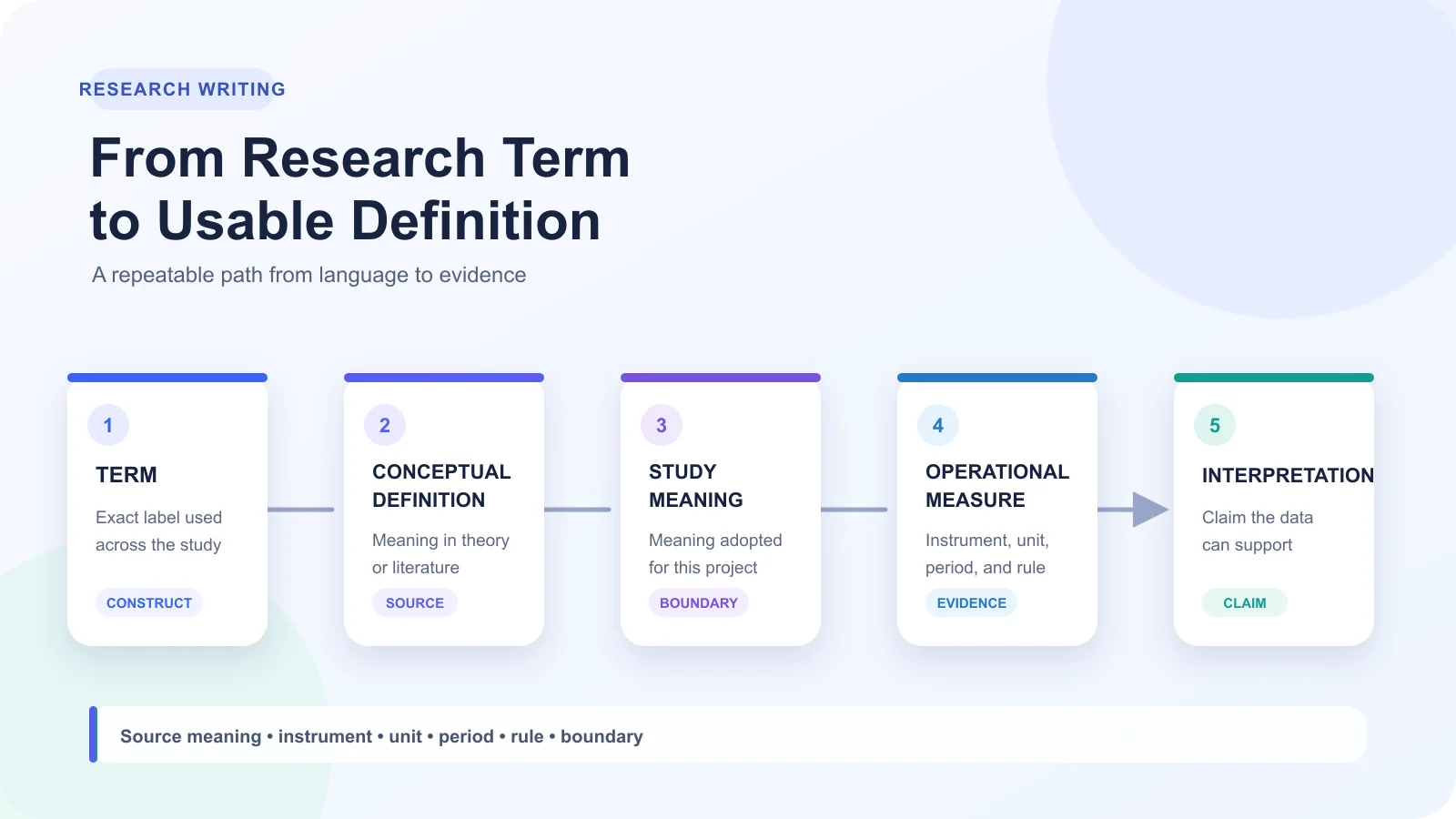
Build the visual from verified text in this order:
- Place each core construct in a node.
- Add its conceptual dimensions underneath.
- Connect each dimension to an observable indicator.
- Connect the indicator to the instrument, data source, or procedure.
- Add the scoring or classification rule.
- Compare every visual label with the research question, Methods section, and definition entry.
Use the Conceptual Framework Generator when the main task is mapping relationships among constructs. Use the Concept Map Generator when the goal is organizing terms, categories, and cross-links. For a procedural route from construct to measurement and analysis, the Text to Diagram Generator can create a visual draft from verified prose.
Keep the diagram and the section synchronized. A visual link is a claim about the study's structure. It needs the same review as a sentence in the manuscript. For the larger methods workflow, the research methodology diagram guide explains how to map inputs, decisions, procedures, analysis, and outputs.
Common Definition of Terms in Research Mistakes
Copying a dictionary instead of defining the study
A general dictionary can explain ordinary usage, but it rarely states the construct, instrument, threshold, or boundary used in a research design. Use the field's literature and the study's method.
Writing a circular definition
"Engagement is the state of being engaged" repeats the term. Name the dimensions or observable rule instead.
Using vague language instead of a decision rule
Words such as "often," "recent," "effective," and "high" transfer the decision to the reader unless the study supplies a frequency, date range, outcome criterion, or cutoff. Replace the adjective with the rule that determines membership.
Treating an instrument name as a complete definition
"Stress was measured with Scale X" omits the version, subscale, scoring direction, time point, and interpretation. Include the details the paper relies on.
Inventing a cutoff without a rationale
If "high," "low," "positive," or "eligible" depends on a threshold, explain where the cutoff came from and how borderline cases are handled.
Omitting the source or rationale
A literature-based definition needs a citation. A researcher-created operation needs a clear "in this study" label and a rationale in the relevant chapter. Without either, readers cannot tell whether the rule is established, adapted, or invented for the project.
Mixing the conceptual and operational levels
A concept is not identical to one proxy. Say what the construct means, then say which part the chosen measure captures.
Defining terms that never appear again
Every entry should earn its place in the question, framework, method, analysis, or interpretation. Delete decorative glossary items.
Changing labels across sections
One cohort cannot become "participants," "users," and "respondents" without a reason. Search the manuscript for every defined term and standardize its use.
Claiming a universal format
Chapter order, capitalization, punctuation, and sorting rules vary. Present a practical default, then follow the governing guide.
Definition of Terms in Research Checklist
- The first sentence states what the section covers.
- Every core construct and measured variable has a clear definition.
- Each conceptual definition comes from a suitable scholarly or authoritative source.
- Each operational definition names the observable procedure or measurement.
- Instruments, versions, units, periods, formulas, scores, and cutoffs are specified where relevant.
- Study-specific choices use wording such as "in this study" or "for this research."
- Conceptual meaning and operational measurement fit each other.
- Terms follow one logical order and one formatting pattern.
- Each term appears in the paper and keeps the same meaning.
- Common words and unused abbreviations have been removed.
- Citations appear in the reference list.
- Placement and style match the institution, department, supervisor, or journal guide.
- Any diagram uses the same constructs, arrows, labels, and boundaries as the manuscript.
Frequently Asked Questions
What is the definition of terms in research?
It is the part of a paper that states how the study uses its important concepts, variables, technical terms, and abbreviations. It may combine literature-based conceptual definitions with study-specific operational definitions.
What is an operational definition in research?
An operational definition states how a study will observe, measure, calculate, or classify a concept. It can include the instrument, procedure, unit, time window, score, cutoff, and interpretation.
What is the difference between conceptual and operational definitions?
A conceptual definition explains what a construct means in theory or disciplinary literature. An operational definition explains how a particular study turns that construct into observable data. A strong variable definition often includes both.
Should definition of terms be in alphabetical order?
Alphabetical order is a practical default for a reference-style section and is required by some programs. Order of appearance or thematic grouping can work when terms depend on one another. Follow the governing guide when it specifies the order.
How many terms should be included?
There is no universal number. Include every term whose meaning affects the research question, design, measurement, population, or interpretation, then remove common or unused terms. A short study may need only a few; a technical thesis may need more.
Where is definition of terms located in Chapter 1?
Many thesis guides place it in the introductory chapter after the problem, purpose, framework, or limitations. Requirements vary by institution and department, so use the official thesis template before a generic online outline.
Do definitions need citations?
Cite conceptual, technical, and instrument-based definitions taken from other sources. A study-specific operational rule may be the researcher's own, but the paper should identify it as a study choice and cite any theory, standard, instrument, or prior method that supports it.
Can a definition include a diagram?
Yes, when relationships, hierarchies, processes, or measurement chains are difficult to scan in prose. The diagram should supplement the written definitions, use the same terminology, and receive the same factual review.
Can I create my own term in a research paper?
Yes, when the existing vocabulary does not express a distinction the study needs. Name the term, explain why it is necessary, connect it to the closest established concepts, and state exactly how the paper uses it. A new label should clarify a real research decision rather than rename a standard concept.
What is the difference between definition of terms and scope of the study?
Definition of terms fixes meaning; scope fixes coverage. A definition may state what counts as a first-generation student, while the scope states which institutions, programs, dates, or participants the project includes. The two sections should agree, but they answer different questions.
What if a term has multiple definitions in the literature?
Briefly compare the definitions that materially affect the study, choose the one that fits the research question and framework, and justify that choice with sources. Then state the adopted meaning explicitly and use it consistently. Do not combine incompatible definitions without explaining how the combined construct will be measured or interpreted.
Should acronyms be included in the Definition of Terms section?
Expand every acronym at first use. Add it to the formal section only when it recurs often, is ambiguous, or represents a substantive concept that needs more than an expansion. A one-time abbreviation usually belongs in the sentence where it first appears, not in a separate glossary entry.
Conclusion: Define the Study, Not Just the Word
Definition of terms in research works best when it tells readers what the study means and how that meaning reaches the data. Select terms that control the question or method. Ground conceptual definitions in appropriate sources. Make operational definitions concrete enough to inspect. Then use the same language in the framework, Methods, results, figures, and conclusion.
The final test for a definition of terms in research is simple: another informed reader should be able to apply the definition without asking what counted, what was measured, or which meaning the researcher intended. If the path from construct to indicator still feels hard to inspect, map it visually, compare the map with the manuscript, and revise both until every link agrees.
Editorial scope: The FigEditor editorial team covers research visual communication and workflow design. This guide was checked against the university and peer-reviewed sources below, but an institution's current thesis manual or a journal's author instructions remain the governing requirements.
References
- American Psychological Association. (2018). Operational definition. APA Dictionary of Psychology. https://dictionary.apa.org/operational-definition
- Andrade, C. (2021). A student's guide to the classification and operationalization of variables in the conceptualization and design of a clinical study: Part 1. Indian Journal of Psychological Medicine, 43(2), 177-179. https://doi.org/10.1177/0253717621994334
- California State University, Chico. (n.d.). Thesis overview. Office of Graduate Studies. https://www.csuchico.edu/graduatestudies/current-students/thesis-project/thesis-overview.shtml
- Caraga State University. (n.d.). Definition of terms. College of Industrial Technology and Teacher Education. https://sites.google.com/carsu.edu.ph/research-1/module-4/definition-of-terms
- Monash University. (2023). Research proposal guidelines. Faculty of Education. https://www.monash.edu/education/students/language-literacy-and-numeracy-development/research-proposal-guidelines
- William Paterson University. (n.d.). Quantitative measurement. In Research design and methods for the Doctor of Education in Leadership. https://press.wpunj.edu/researchmethodsdesign/chapter/11-quantitative-measurement/
Last reviewed and updated: August 2026. Author: FigEditor editorial team.